A new book by James A. Hutcherson · January 19, 2027
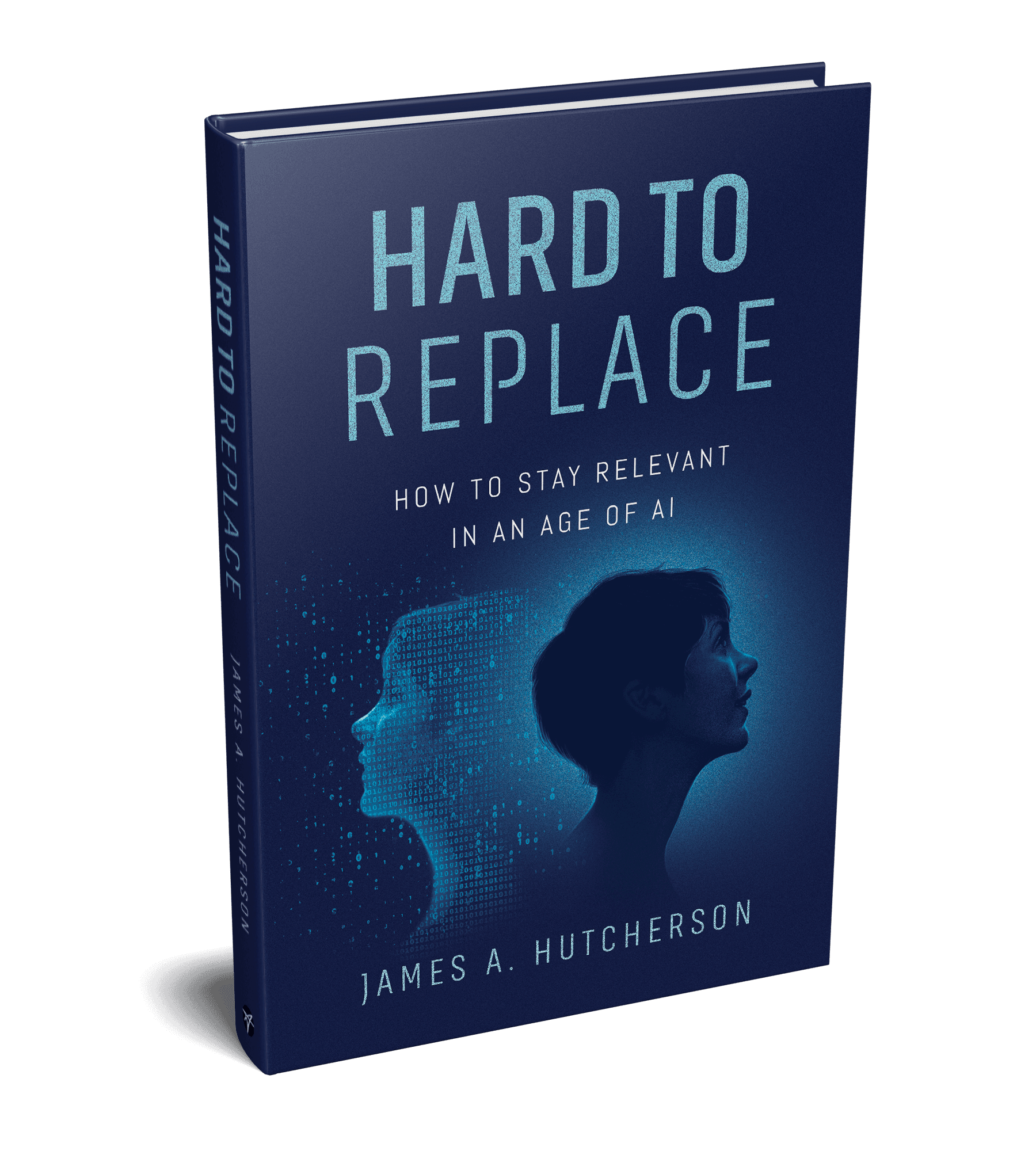
Hard to
Replace
How to stay relevant in an age of AI
Technology executive and career transition mentor Jim Hutcherson draws on forty years navigating three major technology revolutions to reveal the human skills that become more valuable, not less, as machines handle everything else.
Work feels different now.
AI has changed the pace, the pressure, and the way people think about their own value. Hard to Replace is a practical guide for making sense of that change without giving in to panic or hype.
Jim Hutcherson traces the path from personal computing to the internet to AI through the eyes of someone who lived the shifts, missed some signals, learned from them, and kept moving. His story runs from growing up near the Apollo launch pads, to taking a Radio Shack TRS-80 on his first Navy deployment, to helping his wife research her cancer diagnosis at the level her doctors were writing about it.
The book is honest about what change asks of people. It takes on the barriers that keep capable people stuck: identity protection, impostor feelings, analysis paralysis, and the quiet fear that it may already be too late. Then it gives you small steps you can start using right away.
Advantage Media · January 19, 2027
Machines automate tasks.
Humans own outcomes.
At the center of the book is what Jim calls the human constant: five skills that become more valuable, not less, as machines handle everything else.
Judgment
What a machine does: Scores a thousand resumes in minutes.
What you do: Knowing when the technically correct answer will break in the real world, weighing context, history, and consequence all at once.
Creativity
What a machine does: Generates a thousand variations of a logo.
What you do: Asking the question nobody thought to ask. Machines remix patterns. People break them.
Empathy
What a machine does: Records exactly what was said.
What you do: Hearing what someone actually means, not just what they said, and delivering hard truths in a way that builds trust.
Connection
What a machine does: Facilitates communication.
What you do: Bringing people together across functions and agendas, and building the trust that makes people willing to follow you into the unknown.
Purpose
What a machine does: Produces content, but cannot create meaning.
What you do: The rudder that turns change from a threat into a direction. When you know why your work matters, disruption becomes something you can navigate.
“Machines are getting better at tasks. They are not getting better at being human.”
How hard are you to replace?
Five short statements, one for each skill. Pick how often each one is true for you. It takes about a minute, and there's no right score.
Runs entirely in your browser. Your answers are not stored, tracked, or sent anywhere, and they disappear when you leave the page. The optional email signup sends only your email address.
From anxiety to agency
Written for established professionals who are good at what they do and want wisdom over tactics, patterns over tricks. Four parts, in the order you'll need them.
part one
Understanding the Pattern
Massive change has happened before. Calibrate the pace of acceleration and learn the task-role-industry framework.
part two
Overcoming the Barriers
Impostor feelings, corporate dishonesty about AI, and the psychology of resistance that keeps capable people stuck.
part three
Taking Action
Stories of adaptation at any age, the five human skills in depth, and a daily, weekly, and monthly practice.
part four
What's Coming Next
The technologies beyond AI, and why the adaptation skills you build now carry into whatever comes next.

Jim Hutcherson
forty years · three technology revolutions
Jim is a Partner at IBM, where he leads AI-powered transformation and low-code strategy for federal agencies and Fortune 1000 companies. A Navy veteran, he began his career in nuclear power and radar systems before becoming an instructor.
For the past five years he has mentored military veterans and their spouses through the Hiring Our Heroes program, helping sixty-nine people move into civilian technology careers. He is proof of his own principle: adaptation is possible at any career stage.
From the blog
BlogStop Trying to Learn AI
Stop trying to learn AI. It is a tool, not a subject. Nobody learns a hammer in the abstract, and nobody is going to finish that fourteen-week course either.
What My Eight-Year-Old Grandson Expects That You Don't
An eight-year-old sighed at a two-second answer. The lesson hidden in that sigh: much of the fear of falling behind is in the ruler you use, not the race itself.
The Most Future-Proof People I Know Are the Least Technical
The people who will thrive no matter what machines learn to do are often the ones who call themselves 'not technical.' Here is why judgment, trust, and reading a room are the real portfolio.
It's never too late to start.
Missing one wave doesn't doom you for the next. Hard to Replace arrives January 19, 2027.